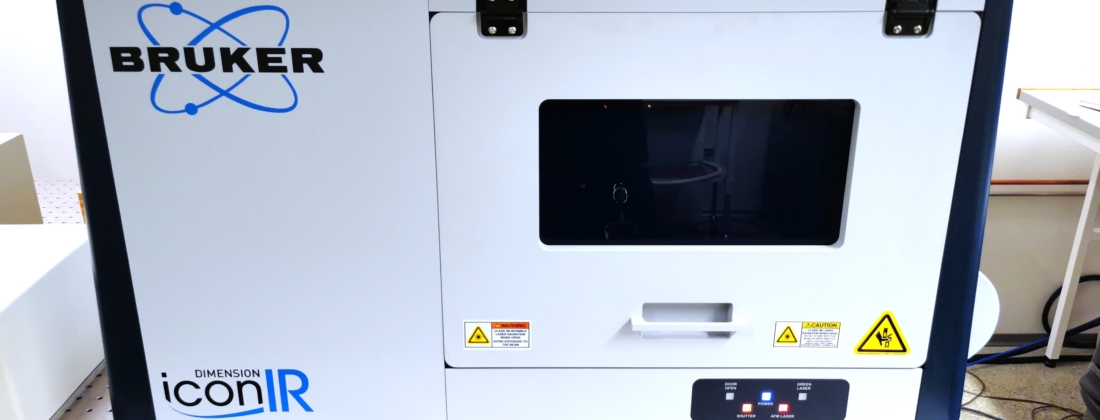
Dimension Icon IR
It is possible now for MAX IV users to characterize their samples with true Atomic Force Microscopy, using the Dimension Icon IR atomic force microscope from Bruker. This AFM is a part of the Infrared Microscopy Platform (IMP) at MAX IV, but it’s usage is not limited to only infrared spectromicroscopy. A plentyful of other force microscopy modes are accessible for sample characterization, including quantitative nanomechanical mapping (QNM) allowing for mapping such sample properties as adhesion, dissipation, elasticity/stiffness, etc. More information about this microscope and the operation modes is available at Dimension IconIR pages under Infrared Microscopy Platform tab.
Sample requirements
The maximum sample size is 10 x 10 cm laterally and 1 cm vertically. We offer 12 mm stainless steel or mica discs for sample mounting. Other options (gold-coated substrates and ultra-flat Si or Au/Si or Au/mica) are available upon timely request. If your sample requres some specific mount, contact the lab staff first.
Maximum filed of view is 90 x 90 um, and maximum hight drop within field of view (FOV) must not exceed 8 um. In practice max FOV is ~ 50 um, and the Z-scanner will struggle to track abrupt height drops of more than 1 um (a gradual, wedge-like height change of less than 8 um is fine though). AFM (including nanomechanical mapping) and AFM-IR are essentially surface-sensitive techniques, and while AHM delivers the surface profile, the depth of probing in AFM-IR ranges from approximately 1-2 um to ~100 nm, depending on the operation mode.
The table below will help you to assess the time budget required for the project. If your sample deems “challenging” this does not necessarily mean that it is impossible to measure, but it is rather a signal that more effort might be required for getting defensible results.
| "Easy" samples | Challenging samples | |
|---|---|---|
| Quantity | Uniform all over the sample area (e.g. continuous polymer film) or optically visible spot(s) | Significant concentration gradient, invisible region of interest (e.g. drop-casted nanoparticles) |
| Roughness | Slowly varying height across the sample, no large abrupt height changes (e.g. ultramicrotome slice of an organic object embedded in epoxy resin) | Heights, slopes and curvatures vary strongly compared to the scan size, rough samples and samples with high porousity (e.g. bone section) |
| Mechanical properties | Same or slowly varying mechanical properties, samples that sit tight on the substrate (e.g. deposited nanostructures or fixated and cut organic objects) | Samples with strongly varying mechanical properties or "sticky" samples (fresh tissue cuts, living cells, electrostatically-bound nano-objects) |
| IR compatibility | Distinct and characteristic IR signatures in region of interest (e.g. protein or lipid bands, polymer blend with components showing different distinct IR signatures) | No characteristic IR bands, bands overlapping, strong bands outside of fingerprint region (we only cover 1800-800 cm-1 today) |
In our microscope IR illumination lands on the sample in top-down geometry, meaning that for the sample immersed in liquid (water) obtaining meaningful IR signatures would be hard if possible at all. For regular AFM a sample immersed in liquid is not a showstopper, however, since this not our regular mode of operation and would require more preparation, talk to the lab staff well in advance if you plan to run AFM on your samples in liquid environment.
Practical information
Unassisted regular AFM use (including QNM) is possible after the respective training is performed, given the users are familiar with the setup. Operator’s help can be arranged upon agreement. Unassisted AFM-IR is not provided at the moment, and must always be conducted by an operator. A small fee is going to be introduced for accessing and using the machine, primarily to cover the consumables and dampen the maintenance costs. The discussion is ongoing, at the moment the machine is free of charge for academic users (scientifically competitive proposals) and paid for commercial users, including those from acdemia (any proposals).