Please read through this page before contacting beamline staff with your queries.
What is absolutely essential to include in a proposal?
- Why XAS or XES: Write why and how XAS/XES (along with secondary techniques available at the beamline) would help answer the scientific question at hand.
- Write if you wish to measure XANES and/or EXAFS. Detection limits, measurement times and methods can vary based on this.
- Write whether you intend to measure XAS via transmission or fluorescence mode. This is essential to determine feasibility and estimate time required for the experiment.
- Samples: Include a comprehensive description of the sample – physical form, solvent/matrix/support, concentration/mass loading, sample environment. This lets the reviewers estimate the X-ray transmission and edge jump at the relevant absorption edges and the suitability of the sample for transmission/fluorescence measurements.
- Sample environment: Include a schematic diagram of any self-designed cell/reactor or other equipment you intend to bring to the experiment. Information on every layer along the path of the X-ray beam (material, state of aggregation, thickness) is required to determine if the experiment is feasible.
- Experimental chemicals/gases/standards: In addition to the samples, add in DUO an exhaustive list of standards, chemicals and gases needed for in-situ experiments and on-site sample preparation (if applicable).
- Measurement plan and time estimate: Include a list of experiments (X samples, Y edges, Z measurements under N conditions; totalTime = X*Y*Z*N + t_setup) to describe how the time estimate was arrived at.
Frequently asked questions
The primary technique needed for my project is XRD. Can I apply to Balder?
At Balder, XRD is offered only in combination with one of the main techniques like XAS or XES. It is recommended to apply to a dedicated XRD beamline instead.
If I need to measure XAS at multiple edges, how can this be optimized?
Broadly speaking, we can group the energy ranges that we can currently access at Balder into three:
- 4 – 13 keV
- 13 – 25 keV
- 25 – 40 keV
Transition between these ranges involves change of monochromator crystals or X-ray optics and is carried out by beamline staff. The change typically takes about an hour, which includes the time needed for thermalization of the optical elements. Ideally, these changes should be kept to a minimum by grouping together all measurements within the aforementioned energy ranges.
Are there any guidelines to estimate the time required for an experiment?
While the exact time needed depends on the specifics of each experiment, here is some useful information:
- Transmission XAS measurements typically take between 1s (for XANES) and 10 s (for EXAFS) for good samples with optimal transmission. For ex-situ samples, we measure multiple (3 to 5) repetitions of every sample.
- Energy changes within 2-3 keV range can, in most cases, be made automatic and takes less than a second. Within this range, several XAS and XRD patterns can be measured in a sequential manner.
- Sample changes in the cryostat typically need about 10 minutes plus additional 5 minutes to reach set temperature. Up to 4 samples can be loaded simultaneously into the cryostat.
- Realignment of the beamline involving change of focusing optics and/or monochromator crystals is typically is done by the beamline staff during office hours and requires 30-60 minutes.
How can I find out if a certain equipment is available at Balder?
Some commonly used equipment is available at Balder or support labs or can be borrowed from the SEDS equipment pool. For experiments involving gases, we are currently unable to provide mass flow controllers or switching valves (updated 202608). Users need to organize these and be able to ship them to MAX IV if granted beamtime.
We use an electrochemistry cell in our lab which uses a static aqueous electrolyte? Can we measure XAS on the working electrode in this cell if we make the windows transparent?
Water radiolysis is a common phenomenon when an X-ray beam passes through an aqueous medium. This could cause anything from bubble formation in the electrolyte resulting in noisy spectra to changing the reaction kinetics at the solid-electrolyte interface. Hence, we strongly recommend maintaining a constant flow of the electrolyte during the measurements.
We have a flow-cell that we would like to use to measure XAS at the Fe K edge. How can we find out if the window material is transparent to X-rays at 7.1 keV?
You can use either XAFSmass (which has a database of several commonly used materials) or the online tool from CXRO to calculate the X-ray attenuation for various materials at different energies.
We have an electrochemistry cell that has been used at other synchrotrons. Is it possible to use the same at Balder?
This depends on the type of measurements (transmission/fluorescence/XES), the edges to be measured etc. Based on this, the cell design may have to be modified for Balder. In this case, please include a schematic diagram of the cell with the exact dimensions (incl. window thicknesses) in your proposal and indicate if this, when granted beamtime, can be modified to be compatible with Balder.
We have a catalyst material with Ni and Pd. Is it possible to measure EXAFS at the Ni K edge and Pd K edge sequentially?
Changing energy between Ni K edge (8.3 keV) and Pd K edge (24.4 keV) involves a change of beamline optics. This cannot be done automatically and is typically done by a beamline scientist. Hence, the experiment needs to be repeated for measuring EXAFS at each one of the above absorption edges.
In contrast, for a Ni-Pt catalyst, EXAFS measurements at Ni K and Pt L3 (11.6 keV) edges can be done sequentially during the same experiment cycle in most cases.
I intend to use multimodal XAS-XRD at Balder? What is the Q-range available with the detector and what information do I need to include in the proposal?
We use an Eiger 1M detector for XRD, whose active surface (ca. 75 x 75 mm) is comparatively smaller in area compared to the ones found at dedicated XRD beamlines. On the other hand, it is mounted on a rail-mounted robot arm for flexible positioning around various sample environments. While we cannot change the detector position during a measurement, we can change the energy (wavelength) to cover different Q-ranges. The energy at which we can measure XRD is constrained by the absorption edge of interest (the diffraction energy is typically within a range of +/- 3 keV from the absorption edge). Hence, in most cases, the resulting XRD pattern is mainly used to observe structural changes qualitatively rather than to perform a complete structure refinement. Hence, it is sufficient to state whether there are phase transitions that you would like to observe in the accessible range. You may optionally include the Q-range (Q = 4π.sin(θ)/λ) of interest.
We have synthesized a new sample which shows a lot of promise functionally. Is it possible to test the signal quality to see if it is good enough for an in-situ XAS experiment?
We offer the possibility to test sample feasibility via fast access mode. Please contact beamline staff if you wish to apply for a fast access beamtime.
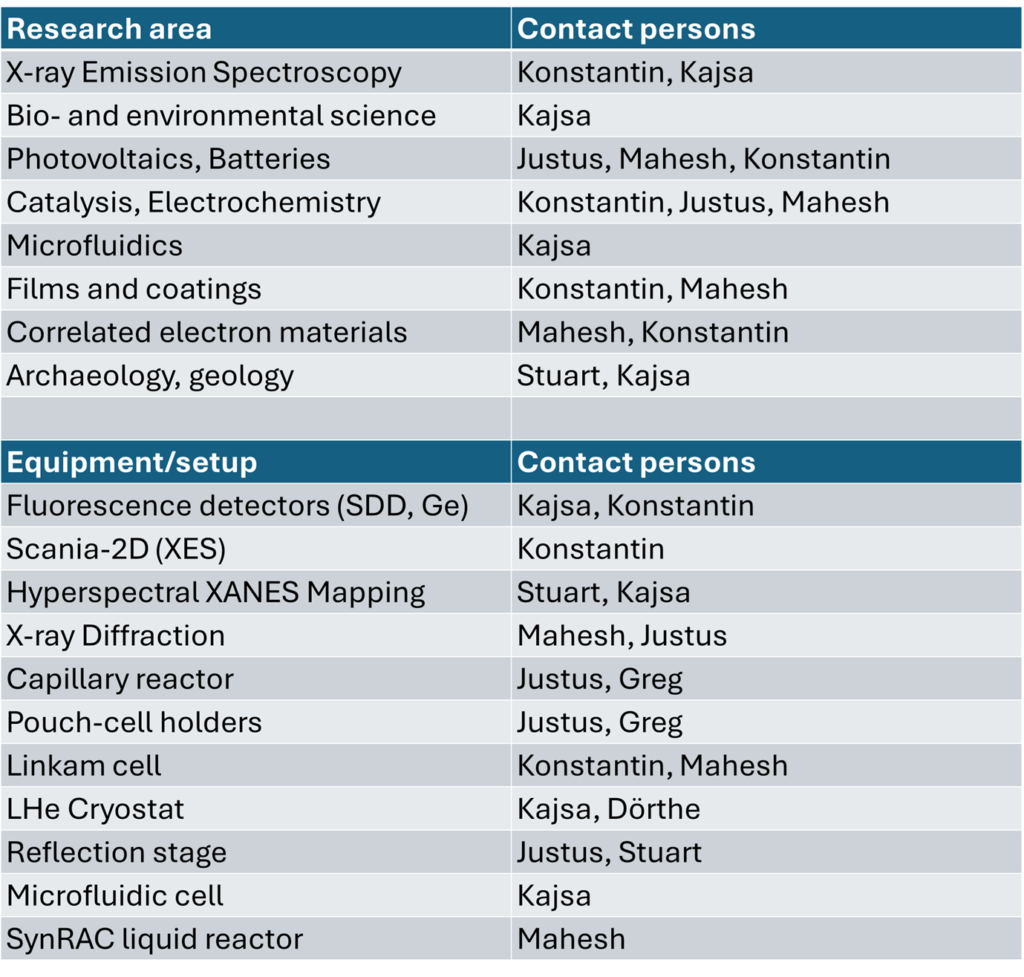
I have more specific questions regarding a future proposal. Who among the beamline staff should I contact?
Any of the beamline staff who are local contacts can be contacted for general queries. The table below lists a non-exhaustive list of fields and possible contact persons: