We have developed a dedicated platform, FragMAXproc, which rapidly processes diffraction data, runs initial refinement and performs hit identification using PanDDA. FragMAXproc organises all data in the project directory and enriches it with extensive metadata in the FragMAX database, allowing full traceability of every sample.
Project data are stored under:
/data/visitors/fragmax/<proposal_number> for academic projects
/data/proprietary/fragmax/<proposal_number> for industrial projects
FragMAXproc is currently run by the FragMAX team. Users need to provide a high-quality, deposition-ready PDB model as input (and CIF files for any non-standard ligands). Please ensure that the model is well refined, as any errors will propagate to all datasets in the campaign.
All datasets collected at BioMAX are automatically processed using autoPROC. Where needed, we can reprocess data, for example in cases of incorrect space group assignment or twinning.
Initial refinement and map calculation are carried out with DIMPLE, ligand restraints are generated with AceDRG, and hit identification is performed using PanDDA and VALDO. Further, we analyse all screening campaigns with cluster4x. Resulting PDB, MTZ and ligand files are collated in the project download directory.
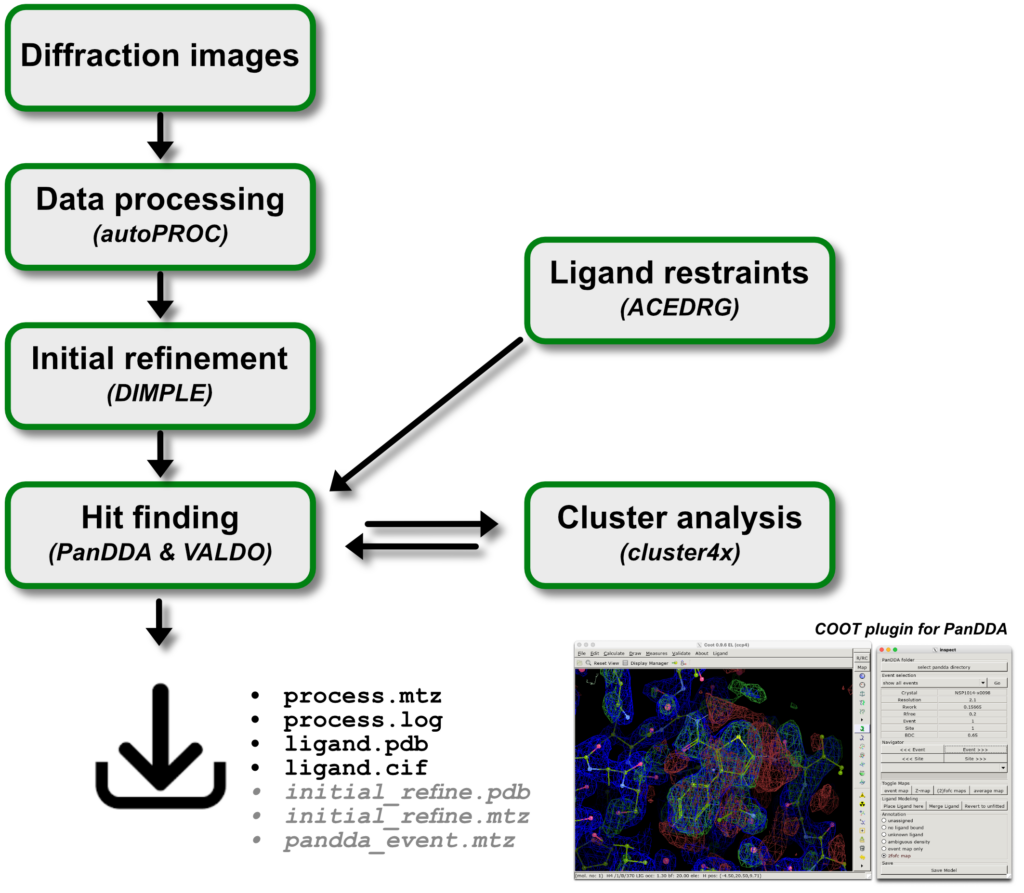
FragMAX data processing flowchart.