Contact mode Atomic Force Microscopy
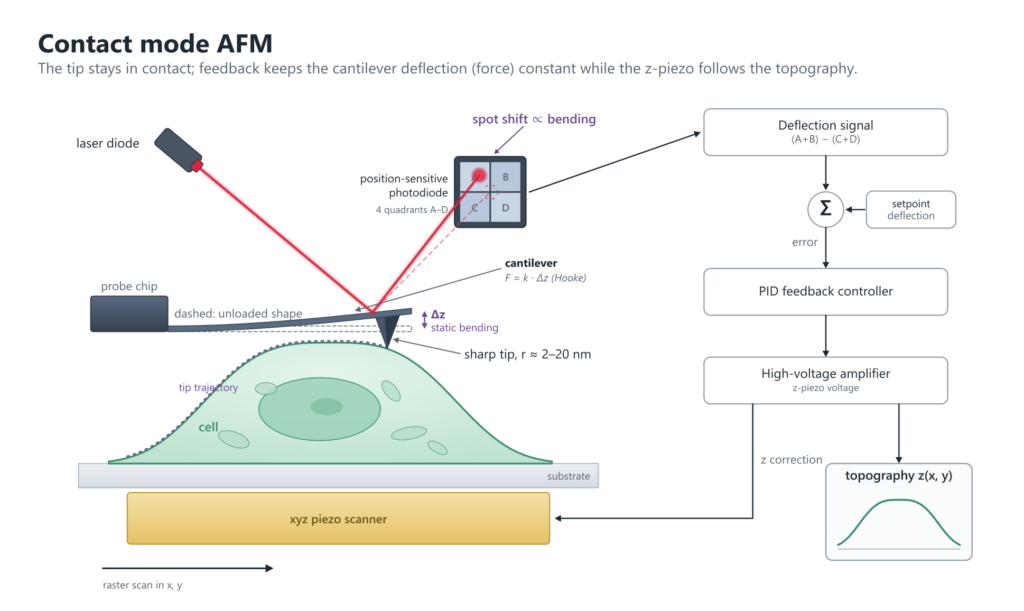
In the contact mode, Atomic Force Microscopy relies on scanning a very sharp tip across a surface of interest at a very close proximity or even touching it. The tip “sits” on a thin flexible stripe, usually metal-coated silicon, called a cantilever. Most commonly, the back of the cantilever is illuminated with laser light, and the reflection is observed on a position-sensitive detector (PSD). Due to a large lever of the light path even smallest bends of the cantilever will result in a measurable reflection travel on the detector. Scanning the sample laterally against the cantilever and monitoring the respective displacement of the reflected light on the PSD, one obtains a height map or topography of the sample. The principle of Atomic Force Microscopy is illustrated below, click to expand the image.
Tapping mode Atomic Force Microscopy
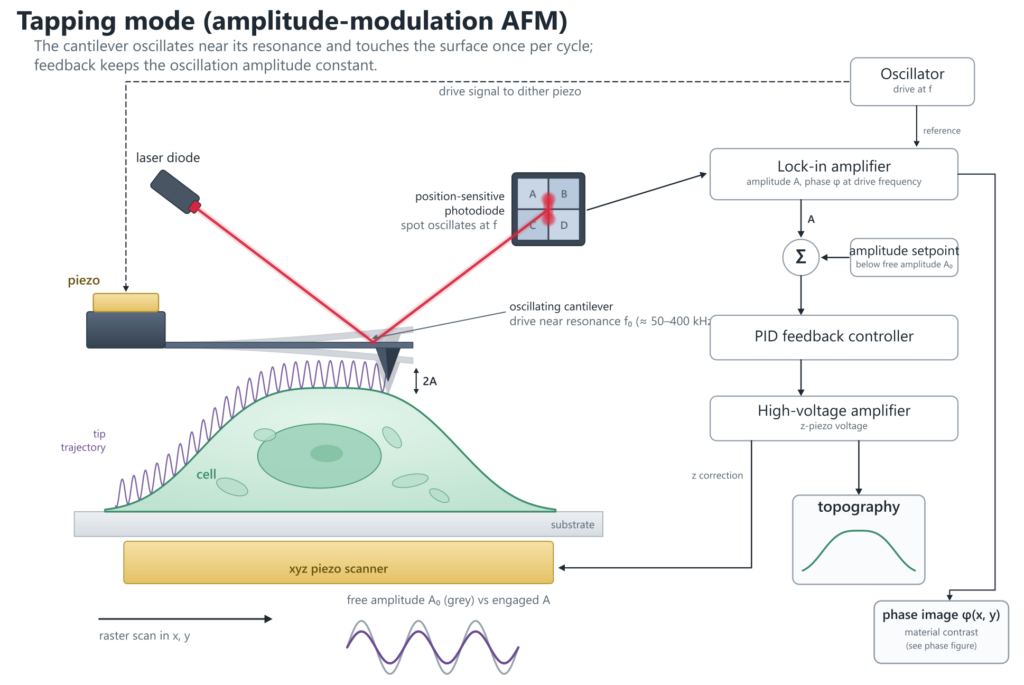
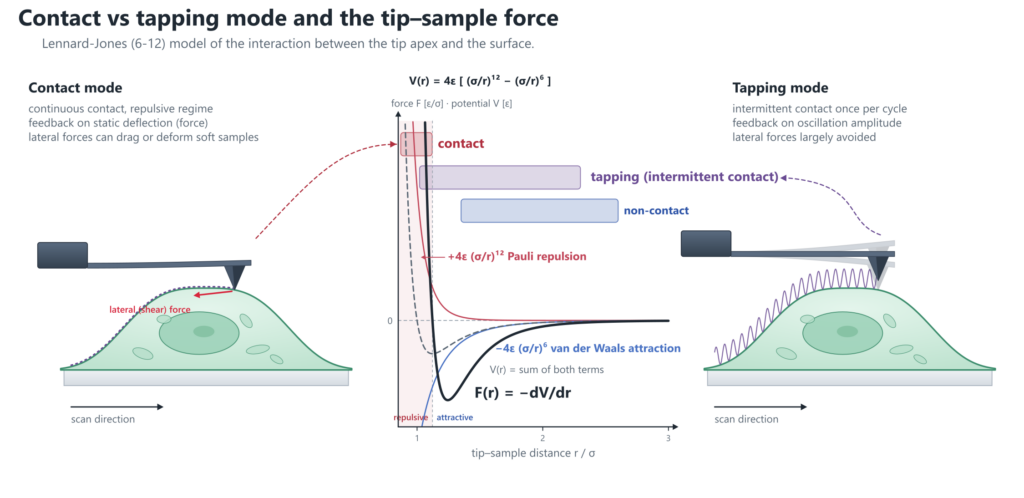
In Tapping mode, the cantilever is vibrated, typically by a shaker piezo, so that it oscillates at a certain amplitude, so called free amplitude A0, close to its resonance frequency f0. Once the cantilever starts to interact with the sample’s surface, its free amplitude dampens by a value, defined by a measure of tip-sample interaction, and the resonance frequency shifts. This new engaged amplitude A can be used as a feedback for vertical positioning of the cantilever when it is being scanned across the sample. The ratio of engaged amplitude A to free amplitude A0 is used for approximate quantification of tip-surface interaction: A/A0 = 0.95-0.75 (or 95% .. 75%) is usually called soft tapping, while ratios A/A0 = 0.75-0.5 (or 75% .. 50%) are referred to as hard tapping. Both tapping modes practically eliminate sheer drag force on both sample and the tip, which naturally occur in contact mode, and are essentially less destructive. The majority of AFM studies today is performed in a tapping mode.
Tapping vs Contact modes in AFM
more to follow here
Peak Force and Quantitative Nanomechanical Mapping
Peak Force(TM) scanning mode is a off-resonance tapping mode (the tip is driven at 2 .. 4 kHz) developed by Bruker, Inc., where at every cycle of tapping a force curve is being recorded and analyzed. This mode provides a precise and direct control of interaction between the tip and the surface, instead of an indirect resonance shift in regular tapping. Sampling force curves in every point of the scan allows for simultaneous extraction of such mechanical properties as sample’s stiffness, adhesion, dissipation and indentation. More information and examples to follow.
Infrared imaging and nanospectroscopy with AFM
more information to follow
Resonance-enhanced AFM-IR (contact)
coming soon
Tapping AFM-IR
coming soon