MicroMAX hosts two experimental hutches (EHs), EH1 and EH2. Currently, all X-ray experiments, including protein crystallography and ptychography, are performed in EH1, while EH2 is primarily dedicated to optical spectroscopy. Future X-ray delivery to EH2 will further expand the available experimental capabilities.
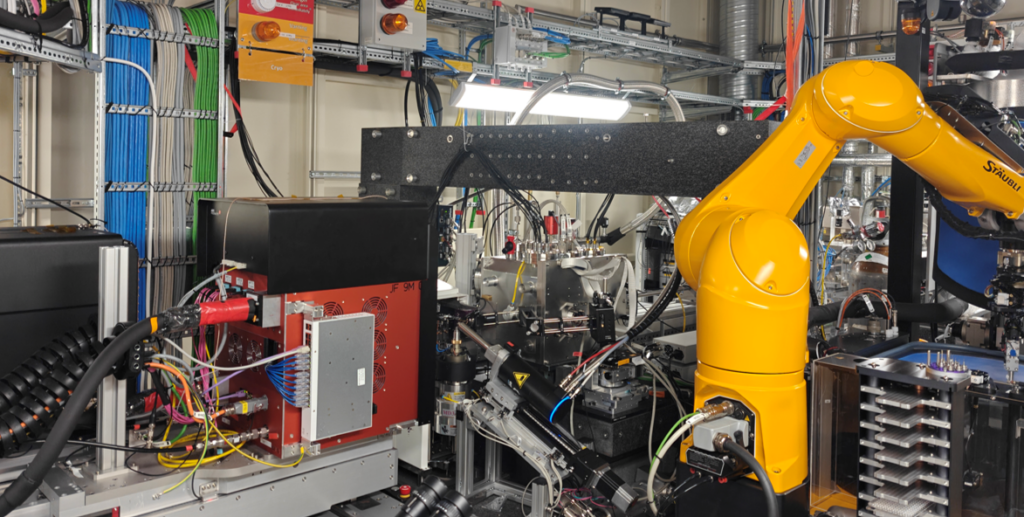
EH1 – Main Experimental Hutch
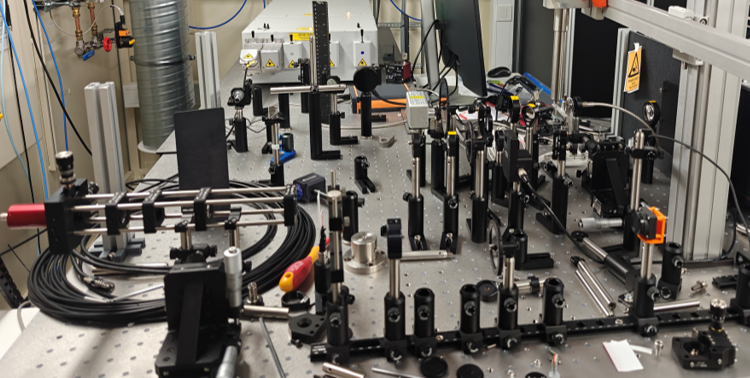
EH2 – UV/Vis Spectroscopy Lab
Experimental capabilities
Hardware, configurations, and technical capabilities:
MD3-up Diffractometer: The spindle axis is mounted in a vertical, upward-facing configuration and provides a sphere of confusion of 200 nm (radius, at 100°/s). The diffractometer is equipped with a range of interchangeable goniometer heads, including a MiniKappa goniometer, an in situ plate holder, and a fast-scanning serial crystallography (SSX) head (under commissioning). An empty base is also available for customized setups, including those based on 3D-printed components.
Detectors: The detector stage has two area detectors, an Eiger2 X CdTe 9M photon-counting detector (245Hz, on-request 560Hz in 4M ROI) and a Jungfrau 9M integrating detector (2 kHz), controlled through Jungfraujoch. An EIGER1M (on loan from Balder) is used for ptychography, with a JUNGFRAU 1M (2 kHz) planned for 2027.
SSX Sample Delivery: high viscousity extruder (HVE) injector (max. 340 µL), serial-X flow, small SPINE-based fixed-target chips (Serial-X Fix, SOS-OS and MiTeGen SSX), large fixed-target chips (under commissioning), TapeDrive (under commissioning).
Xray Chopper: With selectable duty cycles of 70, 35, 18, 9, 4, and 0.8% and rotation frequencies up to 1.1 kHz, the chopper generates X-ray pulses from ~7 ms to <10 µs. The 0.8% and 4% settings use two slots on the chopper disk (repetition rate twice the rotation frequency); the others use four slots.
Sample Changer: Equipped with a double gripper for automatic mounting and unmounting of samples on the MD3-UP diffractometer, enabling simultaneous sample exchange. The cryogenic dewar accommodates 29 Unipucks (464 SPINE sample holders), with an additional Unipuck position available for room-temperature samples.
Cryostream 1000: Features a large 10 mm diameter nozzle and remote operation, including programmable temperature ramping at rates of up to 360 K/h.
Laser: The nanosecond laser system (Ekspla NT-230) delivers 3 ns pulses at repetition rates up to 100 Hz, with a tunable wavelength range of 210–2600 nm. Laser diodes at 405, 450, and 520 nm are currently available for continuous illumination.
Experimental capabilities
All experiments are performed on-site unless otherwise specified.
- Conventional rotation crystallography, single point or helical data collection with automated sample exchange. Beam size: 7- 100 µm (100 – 300 µm, top-hat profile, available on request). Remote access is supported.
- Serial crystallography, using the sample delivery methods mentioned above (no BAG proposals except for small fixed-target chips). Beam size: focus down to 10 × 5 μm² (5 × 5 μm² with pinhole); 4 × 2 μm² with KB mirrors (under commissioning).
- Time-resolved crystallography, triggered by laser or mixing mainly for serial crystallography, laser triggered rotation collection is available on request (no BAG proposals)
- In-situ data collection, supported for crystallization plates of low-profile, such as CrystalQuick, Mitegen InSitu, SWISS-SCI low profile.
- Ptychography, imaging of biological samples under cryogenic conditions (no BAG proposals).
- Offline UV-Vis Spectroscopy, available in association with standard proposal beamtime.