Collaboration with the user community is a core part of MAX IV’s work. One joint initiative is enabled through close interaction with universities, with postdoctoral researchers dividing their time between a university research group and the synchrotron.
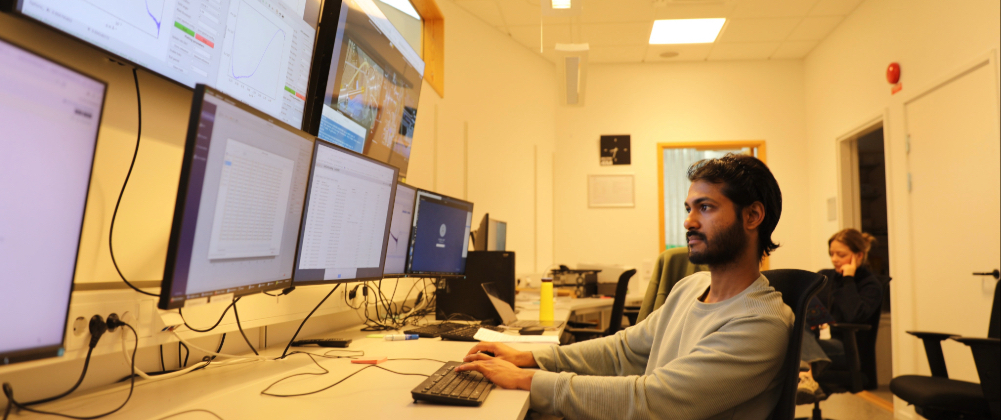
At MAX IV’s CoSAXS beamline, Firoz Malayil Kalathil is one of these shared postdocs.
The postdoc’s perspective
“This shared position allows me to both learn how a beamline operates and work on interesting scientific problems,” said Malayil Kalathil.
In Lund University’s Division of Physical Chemistry, he is part of Felix Roosen-Runge’s research group. There, Malayil Kalathil uses time-resolved SAXS/WAXS to study proteins and soft matter systems. He’s studying elastin, an intrinsically-disordered protein that allows tissues such as lungs and ligaments to stretch and return to their original form. The study focuses on understanding the molecular mechanisms behind this elasticity. He’s also looking at plant seed proteins to understand how to transform them into useful food structures like gels. By studying how these proteins separate into liquid phases and droplets, researchers hope to understand how to control the formation and structure of plant-based protein gels.
“At CoSAXS, I work on the beamline supporting users during their experiments. I am also involved in upgrading the beamline’s sample environment, for example, improving the stop-flow device and contributing to the SUrF setup, which currently integrates SAXS, UV–vis, and fluorescence spectroscopy,” said Malayil Kalathil. He is also working to incorporate Raman spectroscopy into this system.
Malayil Kalathi has also supported the automatization of stopped flow device usage at the beamline. In addition, he has worked with a laser-based set up that induces a temperature jump in the sample and, when paired with SAXS, allows millisecond-resolved structural studies. He is working on improving the set-up for this technique, defining protocols that enable smooth user adoption.
The PI’s perspective
While CoSAXS benefits from Malayil Kalathil’s support, Roosen-Runge’s group is also strengthened by the closer connection to the beamline.
“Beamtime preparation, contact to beamline staff, and data analysis questions are much easier to solve with a postdoc working between the beamline and the group,” said Roosen-Runge. “A shared postdoc enables flows of methodological expertise and information on LSRI as a working place in a very natural way, which also benefits the rest of the group.”
Malayil Kalathil is the group’s first shared postdoc, and Roosen-Runge is open to the possibility of hosting a similar position again.
MAX IV’s perspective
Ann Terry, Group Manager for Soft Materials, currently hosts two shared postdocs at CoSAXS. Simona Bianco is funded in part through RIANA, an EU project. CoSAXS has a long history of hosting shared postdocs, and will add a third member to the cohort soon.
“For the postdocs, the arrangement provides both a scientific home and a strong support network through the research group,” said Terry. “From the beamline perspective, it allows us to utilise our budget effectively to bring different skills, expertise, and projects to the beamline. This helps us support operations, develop new user communities, and expand our experimental capabilities.”