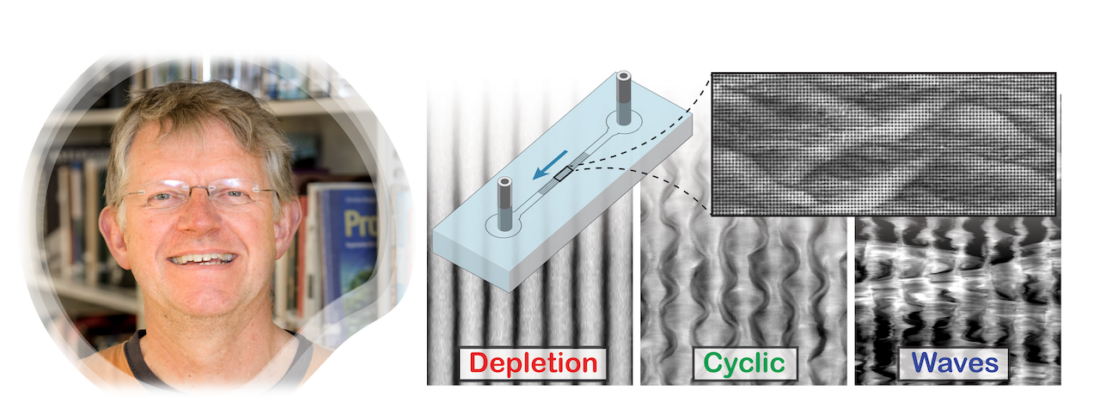
We are excited to kick off the Autumn 2026 MAX4Life talk series with Professor Jonas Tegenfeldt from Lund University. Join us in welcoming our first speaker of the season, who will introduce the emerging field of autonomous fluidics and show how fluid-structure interactions can be harnessed to create self-regulating microfluidic systems.
The MAX4Life series highlights innovative and impactful Life Science research through one-hour talks, followed by Q&A and informal mingling with the MAX IV community.
Talk Title: Viscoelastic fluctuations in microfluidic channels – a tool for microrheometry and for autonomous flow control?
Time & Date: 11:00 to 12:00 on Wednesday, October 21
Location: meeting room MAX II, MAX IV Laboratory
External participants who wish to attend physically can register via the Indico Link. Please use the Zoom Link if attending remotely.
Prof. Tegenfeldt will be at MAX IV for the full day on October 21, we encourage interested researchers to engage with him during his visit.
Abstract:
Viscoelastic fluctuations in microfluidic channels – a tool for microrheometry and for autonomous flow control?
Enrico Turato1, Jason P.Beech1, Ases A.Mishra2, Christelle N.Prinz1, Roland Kádár2, Jonas O.Tegenfeldt1
(1)Department of Physics and NanoLund, Lund University, Lund, Sweden, (2)Computational Mechanics and Materials Eng., Chalmers University of Technology, Göteborg, Sweden
Corresponding author: Jonas Tegenfeldt, jonas.tegenfeldt@fysik.lu.se
In contrast to the predictable flow patterns of Newtonian liquids at low Reynolds numbers, viscoelastic liquids exhibit a broad range of nonlinear instabilities and spatiotemporal fluctuations, even under steady forcing. Fluids are rendered viscoelastic by the addition of small amounts of high–molecular weight polymers, making the field of viscoelastic flow highly relevant for biomedicine and industrial applications.
We have previously explored viscoelastic fluctuations in microfluidic channels as they appear as concentration waves. We found that they can be controlled by fluid composition and channel geometry [1], how their resemblance to turbulence can be used to enhance mixing [2]. We have also shown that breaking the symmetry inside the channels results in flow anisotropy in our devices, i.e. a fluidic diode [3]. In the presentation we will discuss how we exploit these viscoelastic flow fluctuations and the resulting anisotropy as a functional mechanism for microfluidic control and sensing in devices that operate autonomously.
We demonstrate guidance of a liquid in a device consisting of a T-junction with two oppositely arranged fluidic diodes. For a Newtonian liquid the flow is symmetric to the two outlets while for a viscoelastic liquid we see a clear bias of the flow along the favorable direction of the fluidic diode. Here, we also show proof of principle of chemical control of the flow by adding a small amount of detergent to a DNA solution thereby restoring the unbiased flow.
For sensing applications, a short-circuited bridge circuit of fluidic diodes is used for enhanced sensitivity. For Newtonian liquids, it functions like a standard balanced Wheatstone bridge giving negligible flow in the detection channel, whereas for a viscoelastic liquid it functions as a rectifier giving significant flow in the detection channel. For 8MDa PEO we show a limit of detection of at least 10ppm and functionality for volumes as low as 1µL, thereby demonstrating a performance several orders of magnitude better than standard rheometry.
Our long-term vision is to address the central limitation in microfluidics due to the reliance on integrated valves, sensors, and external control systems for complex fluid handling. We introduce the concept of autonomous fluidics, in which fluid–structure interactions encode functionality directly into the system opening up for self-regulated microfluidic circuits with minimal external infrastructure. In the future we hope to apply our findings not only to sensor applications but also to wearable devices and soft robotics.
References
[1] ”Short and Long-range cyclic patterns in flows of DNA solutions in microfluidic obstacle arrays”, Ström, O. E., Beech, J. P. & Tegenfeldt, J. O., Lab on a Chip 23, 1779-1793 (2023)
[2] ”Mixing with viscoelastic waves at low Reynolds numbers”, Turato E., Christelle N. Prinz, Beech, J. P., & Tegenfeldt, J. O., accepted for publication in Lab on a Chip (2026)
[3] ”Using symmetry to control viscoelastic waves in pillar arrays”, Beech, J. P., Ström, O. E., Turato E. & Tegenfeldt, J. O., RSC Advances, 13, 31497 (2023)
More information about Prof. Tegenfeldt’s research work can be found here: Research Group – Jonas Tegenfeldt