TR+ is the MAX IV cross-beamline initiative dedicated to the development and promotion of time-resolved techniques for the life sciences. It currently comprises five beamlines that together cover a broad range of X-ray methods suitable for time-resolved studies of biological systems: X-ray spectroscopy (Balder), crystallography and serial crystallography (MicroMAX, FemtoMAX, BioMAX), and small-angle X-ray scattering (CoSAXS).
By providing access to structural information across different timescales and length scales, these complementary techniques form an integrated toolbox for investigating dynamics in molecular biology.
TR+ serves not only as a platform for cross-beamline collaboration, enabling the joint development of technical solutions to shared challenges, but also—most importantly—as a community-oriented initiative. Outreach and education are central components of TR+, alongside continuous dialogue with the scientific community. This sustained exchange pursues two main objectives: first, to inform the community about the latest developments, capabilities, and achievements in time-resolved research at MAX IV; and second, to learn from the community about emerging challenges, scientific needs, and frontier applications of time-resolved techniques, which in turn guide and shape the technical development goals of TR+.
FemtoMAX overview
FemtoMAX facilitates time-resolved X-ray diffraction and scattering experiments, techniques that captures ultrafast changes in materials at different time points. Such studies are of fundamental importance for key scientific problems directly relatedto programming materials using light, enabling new storage media and new manufacturing techniques, obtaining sustainable energy by mimicking photo-synthesis and gleaning insight into chemical and biological functional dynamics.
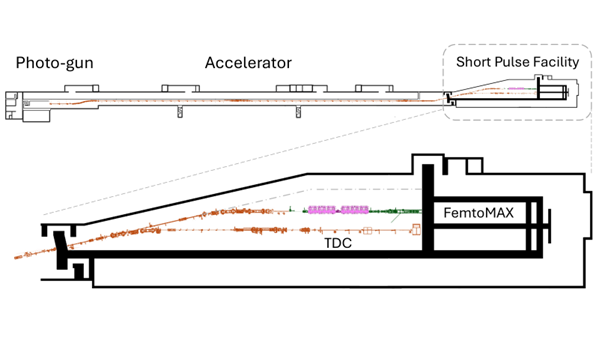
Specifications for FemtoMAX
| Key methods: Femtosecond time-resolved X-ray scattering from crystals . |
| Applications: Phase transitions, photoactivated reactions (laser pump X-ray probe), THz pump X-ray probe, material control with light. |
| Sample delivery: Fixed target. Flow-based systems is an option. Cryo cooling. |
| Triggering: Laser light 400 nm – 1600 nm, THz pump triggering. Time resolution 50 fs, time delays: 50 fs up to 100 µs. |
| Data processing: Automated indexing and integration pipelines in development that will provide feedback to users. |
| Detector: Pilatus 1.2 M (253 x 142 mm), 20 bit depth |
MicroMAX overview
The MicroMAX beamline is specialised in serial crystallography and time-resolved crystallography methods, yielding molecular structures of biomolecules with angstrom resolution. MicroMAX can examine reactions from 10s of microseconds (photo-activated) to milliseconds (diffusion-limited mixing) or greater. MicroMAX is complemented by BioMAX to collect structures from crystals, and benefits from information on assemblies collected at CoSAXS or chemical identities collected at Balder.
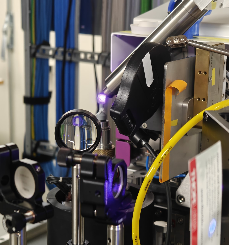
Specifications for MicroMAX
| Key methods: Time-resolved crystallography, Serial crystallography, Macromolecular crystallography, Ptychography |
| Applications: Enzyme catalysis, photoactivated reactions (“pump-probe”), ligand binding and reactions (“mix-chase”), transient, inhibitory, or trapped states of proteins, temperature and humidity changes (“4D SSX”) |
| Sample delivery: A variety of single crystal and multi-crystal (serial) flow-based and fixed-target sample delivery systems are currently offered allowing one the select the delivery method most appropriate for the research goal. Many methods are also compatible with light-sensitive and/or anaerobic conditions. |
| Triggering: Light-triggered reactions can be investigated down to the 10s of microseconds. This is enabled by rapid light triggering using a nanosecond laser system, high X-ray flux with x-ray chopper, and fast detection integrating detector. Chemical triggering can be observed in the low millisecond (diffusion limited) time scale. |
| Data processing: Real-time spotfinding, and automated indexing and integration pipelines provide rapid feedback, allowing users to observe electron density maps often within a few hours. Serial experiments require that unit cell parameters are known. This pre-characterization can be performed at MicroMAX or BioMAX. |
| Examples: User stories to be added in public-facing format. Acoustofluidic focussing in SSX |
Events
The TR+ (Time‑resolved) cross-beamline initiative at MAX IV is building a focused programme of webinars, workshops, data clinics, and hands‑on trainings designed to advance time‑resolved capabilities across the user community. These events share cutting‑edge methods, practical know‑how, and direct access to beamline experts supporting researchers in developing and executing time‑resolved experiments as per their needs.
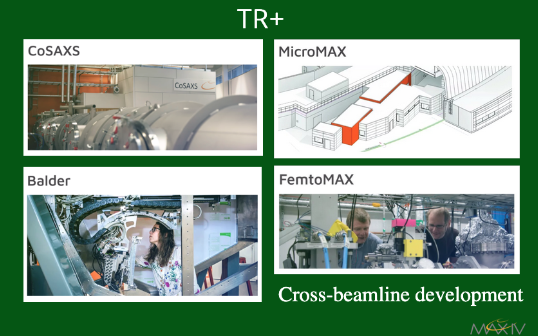
TR+ webinar and information exchange dialogue : April 29, 2025
This introductory webinar, hosted by the TR+ (Time‑resolved) cross-beamline initiative at MAX IV, brought together the community to explore high‑impact time‑resolved experiments and techniques. It focused on how TR+ can best support time‑resolved studies in the life sciences and beyond.
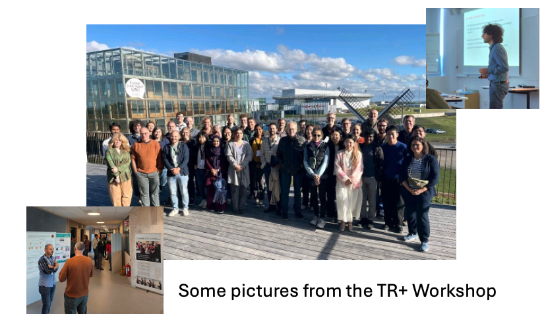
TR+: Time-resolved methods for Life Sciences at MAX IV :
September 24 -26, 2025
The TR+ in association with LINXS ChemLife theme, held a workshop showcasing synchrotron techniques for studying biomolecular dynamics across diverse length and time scales. Participants explored applications of X‑ray spectroscopy, scattering, serial crystallography, and multimethod approaches, with practical sessions on sample delivery, reaction triggering, and large‑scale data analysis. Scientific case studies, expert panels, posters, and facility tours provided researchers with direct opportunities to refine ideas for future time‑resolved experiments.
.jpeg)
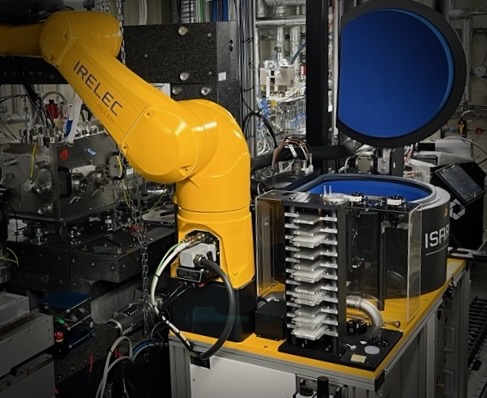
Serial Synchrotron Crystallography hands-on training at MicroMAX: 24-26 Nov, 2025
This two and a half days workshop offered intensive training in modern SSX techniques. Participants gained practical experience in sample preparation and delivery, data collection at MicroMAX, and downstream data analysis, equipping the researchers with the skills needed to perform high‑quality serial crystallography experiments.