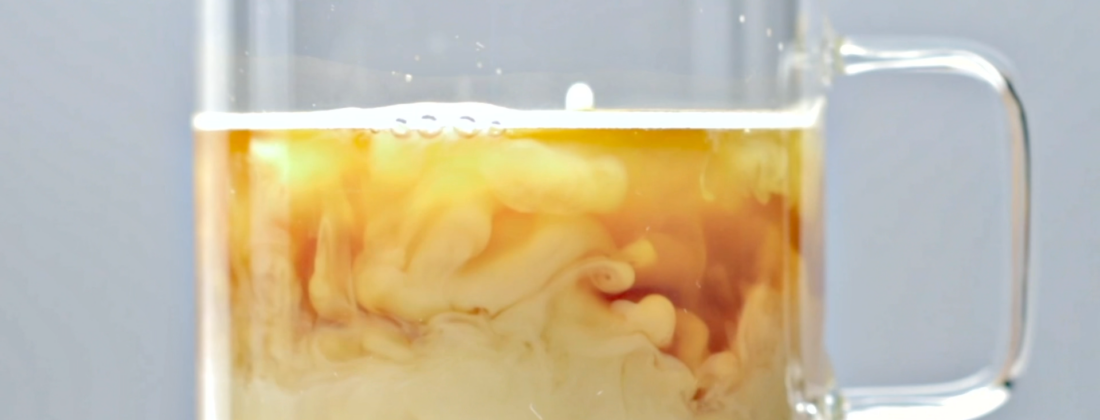
It’s a morning routine: pour milk into coffee and watch the liquids come together in swirls. The pattern is familiar, but the behavioural patterns driving these swirls are hidden from coffee drinkers.
A team of researchers from Chalmers University of Technology and MAX IV took on the challenge of studying how tiny particles – at the nanoscale – behave when a liquid begins to swirl. They wanted to study whether nanoparticles in these swirls follow the familiar patterns we see with the naked eye.
“We tend to assume that what we can visualise macroscopically happening in a fluid also tells us what is happening at smaller scales,” says Roland Kádár, professor at Chalmers University of Technology. “Questioning this may seem simple, but it is a fundamental multiscale flow challenge that requires an advanced combination of techniques and competences.”
To do this, they needed to develop a method that would let them control and observe the swirling of the liquid and track the movement of the nanoparticles in the liquid. The Taylor-Couette (TC) flow, in which one cylinder is placed in another with liquid between the two, is a classical physics flow stability problem. The inner cylinder rotates, spinning until the liquid forms swirls called vortices. As that inner cylinder spins faster, increasingly complex swirl patterns emerge in the liquid.
In this experiment, the researchers added two very different types of nanoparticles to the liquid: graphene oxide, which are plate-like nanoparticles, and cellulose nanocrystals, which are rod-like nanoparticles.
They used polarised light imaging (PLI) to observe the large swirling patterns without the addition of any visualisation aids that would disturb observations on the nanoscale. The researchers then used Small-Angle X-Ray Scattering (SAXS) at MAX IV’s ForMAX beamline to track the nanoparticles at speeds a thousand times faster than previously possible. When doing SAXS experiments, researchers shine X-Rays at an object, measure how the rays scatter, and use the scattering pattern to track how small structures change and move. Fourth-generation synchrotron technology at facilities like MAX IV lets scientists observe materials at different scales, from tiny to large, in real time. ForMAX is particularly well suited for this kind of study.
Three methods were combined to allow Kádár and his team to study the nanoparticles in motion. They combined X-rays and polarized light imaging with controlled fluid flow so that they could study tiny structural changes in real time – a new method they call TC-PLI-SAXS. This was enabled by ForMAX’s strengths in time-resolved studies of materials at the nanoscale.
This is a perfect example of the impact we envisioned with the development of multiscale, multimodal and time-resolved capabilities at the ForMAX beamline. The TC-PLI-SAXS experiment opens up the possibility of designing an entirely new class of experiments on complex fluid flows.
Kim Nygård, beamline manager at ForMAX
Using the combination of the three techniques, the researchers saw that while the graphene oxide particles followed the swirls regardless of how complex the flow patterns became, the much smaller cellulose nanocrystals consistently did not. Instead, with the development of wavy vortices, the cellulose particles no longer mirrored the full complexity of the flow patterns. This finding suggests that the cellulose nanocrystals quickly lose track of the motions of some slower motions of the large swirls.
“This multiscale perspective, where we can probe multiple length scales simultaneously, could help advance our understanding of numerous mass-transport problems,” Kádár says.
TC-PLI-SAXS paves the way for new flow dynamics synchrotron experiments. Understanding how tiny particles respond in moving fluids could eventually help improve processes involving complex materials, from food, cosmetics and pharmaceuticals to energy technologies and advanced new materials.
There’s more to a cup of coffee than meets the eye!