The electrochemistry setup is designed for performing photoemission measurements at solid-liquid or liquid-gas interfaces in a dip-and-pull geometry or inside a flow cell.
Dip-and-pull (meniscus) method
A three electrode setup can be dipped and then pulled out of a beaker of liquid electrolyte solution to form a thin electrochemically active interface that can be probed with AP -XPS or -XAS
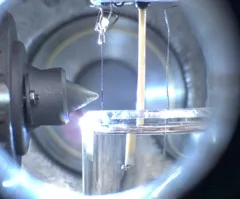
| Base pressure | 5 x 10⁻⁷ mbar Cell not bakeable |
| Pressure range | 5 x 10⁻⁶ mbar – 30 mbar |
| Top (sample) manipulator | X, Y, Z, R motorised |
| Bottom (beaker) manipulator | X, Y, Z motorised |
| Electrode info | Typical working electrode dimension: 7mm x 50mm (w x h). Leakless Ag/AgCl reference electrodes are available on request. Maximum reference electrode diameter of 5 mm. Contact beamline staff to discuss sample/electrode requirements if uncertain. |
| EC sample holder | 3-electrode setup: WE, RE, and CE placed one after other, each separated by ~7 mm. Sample holder can be easily removed from manipulator for electrode/sample exchanging. Two identical sample holders are available |
| Beaker | Can hold beakers up to 50 mm diameter and up to 60 mm height. Available beakers of 30, 60, 100, and 150 ml volume. Users can bring their own beakers. Heating or cooling can be provided via temperature-controlled platform on which beaker stands. |
| Electrolyte info | Many electrolyte solutions can be used, with the exception of some strong acids that are corrosive to the stainless steel chamber. Please contact the beamline to discuss electrolyte compatibility. Perchloric acid is only permitted with <0.1M concentration. |
| Potentiostat | Bio-Logic SP200. E range +/- 10V. I range +/- 500 mA. |
| Glove box | A custom glove box can be attached to allow handling/loading of samples in inert/dry Ar or N2 atmospheres 1<ppm O2 and H2O) |
| Light sources | A solar simulator is available, suitable for photoelectrocatalysis experiments |
| Availability | Available to general users |
Flow cells
HIPPIE has two types of flow cells: Leiden/FHI (J. Velasco Velez et al., Faraday Discussions 236, 103 (2022)) and RedoxMe/Diamond (S. Kumar et al. JPhys Energy, 6 036001 (2024)) designs. Both cells can be used for APXPS with an ion-exchange membrane (IEM) and for APXAS with both IEM and a SiNx window. The cells implement a three-electrode cell design with miniature Ag/AgCl reference electrode and Pt wire coounter electrode.
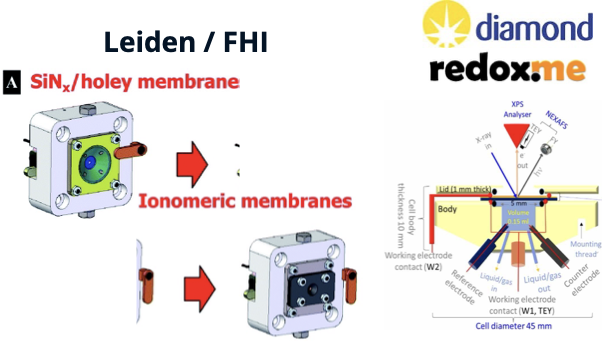
| Pressure range | 5 x 10⁻⁶ mbar – 30 mbar |
| Cell manipulator | X, Y, Z, R motorised |
| Sample preparation for EIM | The sample-membrane composite needs to be conductive. There are multiple approaches to ensure it, depending on the membrane type and the samples. Please contact the beamline staff to discuss the sample preparation procedure. Useful resources: S. Kumar et al. JPhys Energy, 6 036001 (2024) https://www.doi.org/10.1088/2515-7655/ad54ee J. Counter et al. https://doi.org/10.26434/chemrxiv-2026-4ddq |
| Sample preparation for SiNx membrane | The sample should be deposited on the SiNx membrane as a thin film or drop-cast from a powder suspension. Please contact the beamline staff to discuss the sample preparation procedure. |
| Electrolyte info | Many electrolyte solutions can be used, with the exception of some strong acids that are corrosive to the stainless steel chamber. Please contact the beamline to discuss electrolyte compatibility. Perchloric acid is only permitted with <0.1M concentration. |
| Potentiostat | Bio-Logic SP200. E range +/- 10V. I range +/- 500 mA. |
| Light sources | A solar simulator is available, suitable for photoelectrocatalysis experiments |
| XAS detection method | IEM: AEY using electron spectrometer, TEY (sample drain), TEY (through analyzer cone) SiNx window: TFY, TEY (sample drain) |
| Availability | Available to general users |