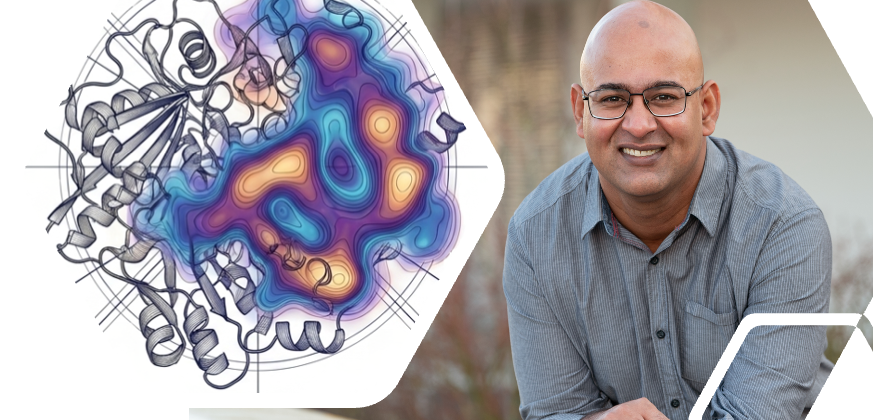
Warm welcome to Dr. Ashwin Chari from MPI, Göttingen as our next speaker in the MAX4Life Talk Series for Spring 2026!
The MAX4Life series highlights innovative and impactful Life Science research through one-hour talks, followed by Q&A and informal mingling with the MAX IV community.
Talk Title: “Towards Routine Quantum Crystallography of Biological Macromolecules
Dr. Chari will present a state‑of‑the‑art high‑energy protein crystallography workflow developed at the EMBL P14 beamline (PETRA III), enabling low‑damage, high‑signal data collection for challenging macromolecular systems. The approach delivers routine atomic and sub‑Å resolution datasets from single crystals, reaching near single‑electron accuracy. These advances allow direct visualization of enzyme active sites and reaction mechanisms using aspherical atom refinement, leading to revised chemical models of enzyme function.
Time & Date: 11:30 to 12:30 on Wednesday, May 13
Location: meeting room MAX III, MAX IV Laboratory
External participants who wish to attend physically can register via the Indico link. Please use the Zoom link if attending remotely.
Dr. Chari will be at MAX IV for the full day on the May 13, we encourage interested researchers to engage with him during his visit.
Related external event:
Diffraction Methods in Structural Biology 2026 : Limitations and Expansions of Diffraction Methods, Berlin, July 20-25
Abstract:
Towards Routine Quantum Crystallography of Biological Macromolecules
Ashwin Chari1,*, Elham Paknia1, Claus Flensburg2, Clemens Vonrhein2, Rasmus Fogh2, Peter Keller2, Thomas R. Schneider3, Clemens Schulze-Briese4, Michal Chodkiewicz5, Paulina Dominiak5, Gleb Bourenkov3, Gérard Bricogne2
(1) Research Group for Structural Biochemistry and Mechanisms, Max Planck Institute for Biophysical Chemistry, Am Fassberg 11, D-37077 Göttingen, Germany; (2) Global Phasing Limited, Sheraton House, Castle Park, Cambridge CB3 0AX, UK; (3) EMBL Hamburg Unit c/o DESY, European Molecular Biology Laboratory, Notkestrasse 85, 22607 Hamburg, Germany; (4) DECTRIS Ltd. Täfernweg 1, 5405 Baden-Dättwil, Switzerland; (5) Biological and Chemical Research Centre, Department of Chemistry, University of Warsaw, ul. Zwirki I Wigury 101, Warsaw, 02-089, Poland.
Corresponding author: ashwin.chari@mpinat.mpg.de
This presentation consists of two parts. First, I will introduce a novel concept of high-energy data acquisitionwith a highly optimized setup and workflow for protein crystallography. The setup is implemented at the EMBL beamline P14 at the PETRA III storage ring at DESY (Hamburg, Germany). It delivers variable-size top-hat beams, that are particularly important in structural studies of large macromolecular complexes [1,2] and in ultra-high-resolution studies of enzymatic mechanisms under precise dose control. The combination of a high-flux collimated mode with a detector of high quantum efficiency at 26.687 keV increases data quality by reducing radiation damage and enhancing the Signal-to-Noise ratio [3]. To further improve data quality, Global Phasing Ltd.’s workflow has been deployed on P14 through its interface to MXCuBE2 ([4], § 4.4.7). Crystal symmetry and orientation are first determined, then used together with knowledge of the MD3-goniostat’s reorientation capabilities to design a multi-orientation strategy aiming at achieving completeness (no cusps) and uniformity of redundancy, within a “dose budget” adapted to the target resolution [5]. The workflow then directly drives the execution of that strategy via MXCuBE2.
In the second part, I will present how the implementation of these procedures allows us to routinely collect single-crystal datasets at atomic and sub-Å resolution. The precision of these datasets and the accuracy of the models derived from them effectively allow us to achieve single-electron accuracy in protein X-ray crystallography. This has enabled us to assess the impact of radiation damage in sub-Å resolution datasets. A first study at 0.55 Å resolution reveals extensive small conformational changes in response to dose [6]. We have also determined a 0.43 Å structure of Rubredoxin which reveals 50% of the bond mid-point electron densities between all second-row element atoms in the structure. By connecting the DiSCaMB library [7] to BUSTER [8], we are able to use transferable aspherical atom model (TAAM) for the refinement of sub-Å protein structures. This enables a direct visualization of enzyme active sites and enzymatic reaction mechanisms by means of cryo-trapped snapshots. On the basis of these new insights, we are forced to redefine the chemical structure of several enzyme active sites and revise enzymatic reaction mechanisms. I will discuss how the accurate, detailed visualization of a wide variety of enzyme reaction mechanisms will benefit from highly precise crystallographic data together with TAAM and/or other forms of aspherical atom refinement.
References
[1] Schrader et al. (2016) Science 353, 594-598.
[2] Singh et al. (2020) Cell 180, 1130-1143.
[3] Storm et al. (2021) IUCrJ 8(6)
[4] Oscarsson et al. (2019) Journal of Synchrotron Radiation 26, 393-405.
[5] Fogh et al. (2026) Acta Cryst D, submitted
[6] Bourenkov et al. (2026) Acta Cryst D, submitted
[7] https://github.com/discamb-project/DiSCaMB
[8] Bricogne et al. (2017) BUSTER version 2025-07-17 Cambridge UK, Global Phasing Ltd.
More information about Dr. Chari’s research work can be found here: Research Group-Ashwin Chari