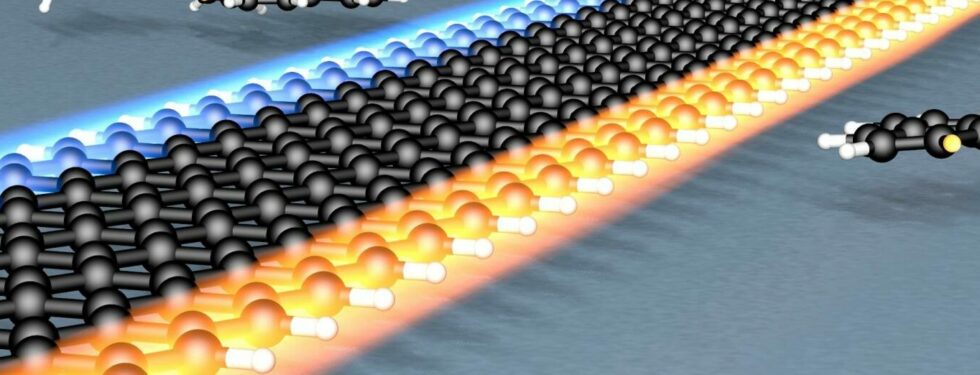
Illustration of zigzag graphene nanoribbon monolayer

Zigzag graphene nanoribbons’ surface state hints at spin-polarized channels’ potential practical applications

An international team of researchers confirmed that epitaxial zigzag graphene nanoribbons grown on mesa-structured silicon carbide form protected spin-polarized transport channels at room temperature with very weak spin–orbit interaction. They discovered that while the zigzag graphene nanoribbon monolayer sank almost completely into a silicon carbide facet, its lower edge dissolved and mixed with the silicon
Highlights

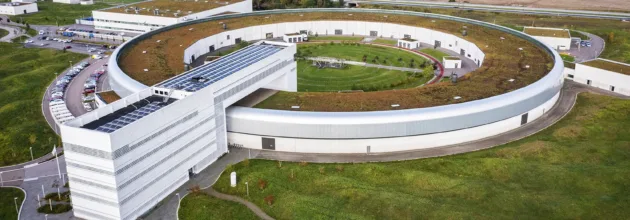
Drone image of MAX IV from above, surrounded by green landscape and the horizon.

A record year for research at MAX IV

MAX IV is making significant societal contributions in terms of record-high scientific productivity. In 2023, the number of publications increased by 51% compared to the previous year, and the number of unique users increased by 31%. Moreover, the number of proposals submitted in the most recent Open Call was higher than ever.

9y9a9159 2

Conceptual design for three potential new beamlines developed with WISE

After successfully bringing the first 16 funded beamlines into operation, we now look into the future. In collaboration with the Wallenberg Initiative Materials Science for Sustainability (WISE), funded by the Knut and Alice Wallenberg Foundation and together with the scientific community, MAX IV will develop the conceptual designs for three potential new materials science beamlines.