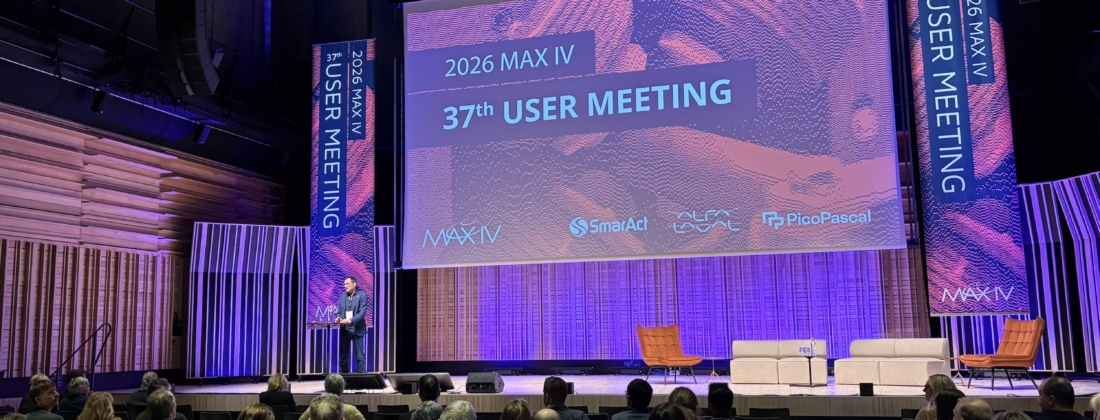
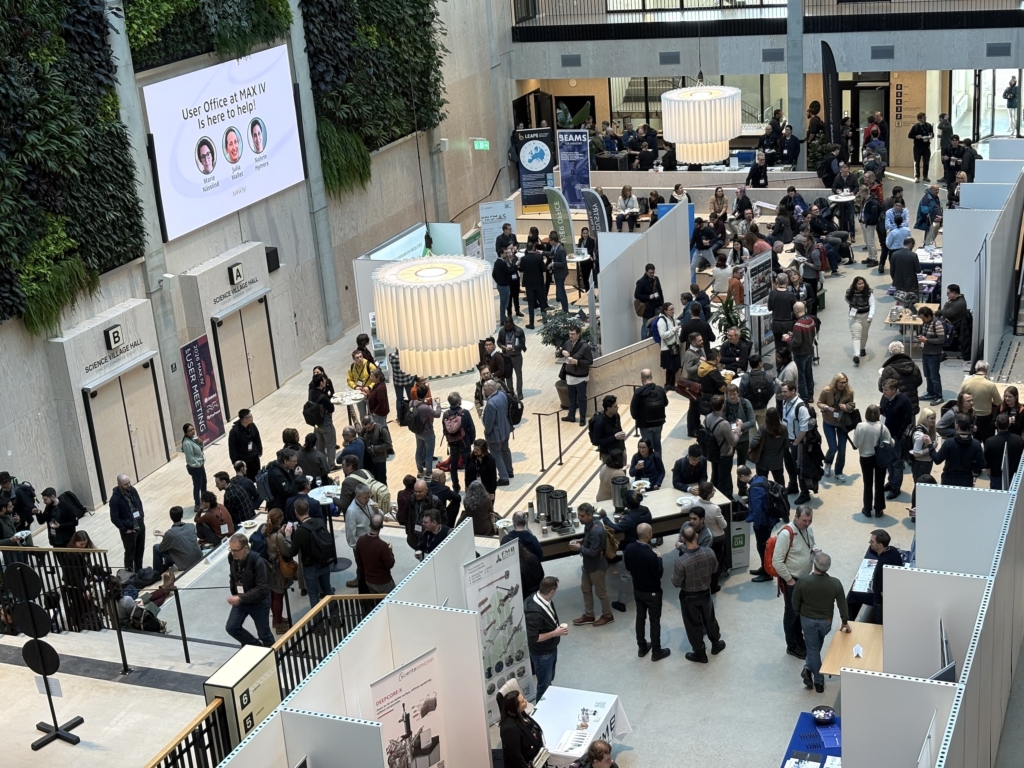
The MAX IV 37th User Meeting took place from January 19-21 at The Loop, a bright new venue in Lund. A record number of 475 participants brought an undeniable energy and engagement which spanned varied scientific interests and industry-relevant topics. This energy was felt in the waves of applause in the main hall during plenary talks, in full rooms during parallel session, and between sessions, when open spaces swelled with researchers and engineers who took to networking or visiting the booths of industry sponsors. All told, a great success and a special opportunity for MAX IV user communities and industry partners.
The User Meeting theme, the accelerator upgrade project MAX 4U—a first global upgrade of a 4th generation light source—was integrated throughout the programme to provide attendees details of breadth, depth, and impact for future research at MAX IV. This included an open invitation to participate in development of the MAX 4U science case.
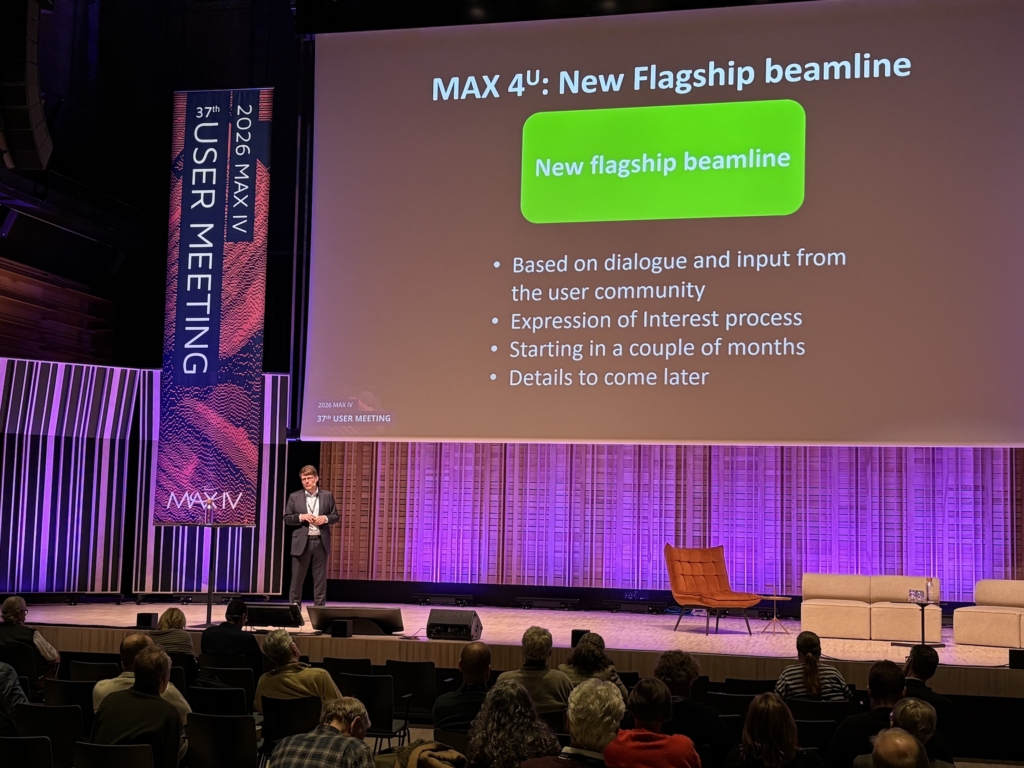
Director Olof ‘Charlie’ Karis opened the meeting with updates on important topics, including positive news for the recent Operational Review by the Swedish Research Council, Vetenskapsrådet (VR), the Roadmap, Annual Report with science highlights, and introductions for the new Industry website BEAMS.se and the National Excellence Clusters supported by MAX IV. Concerns for long-term facility funding and global challenges with large volume data handling were also outlined.
MAX IV Science Director Joachim Schnadt covered the development status of the WISE beamline TomoWISE, exciting MAX 4U details and science case including planning for a flagship beamline, new beamline cycles, access modes, and the latest Beamline Portfolio review for users.
VR Director General Katarina Bjelke highlighted the importance of MAX IV as a leading national facility aligned with European scientific excellence. Director Bjelke named the MAX 4U upgrade, quantum research, and the Swedish National Excellence Clusters among key strategic drivers of success.
Watch video highlights from the MAX IV 37th User Meeting:
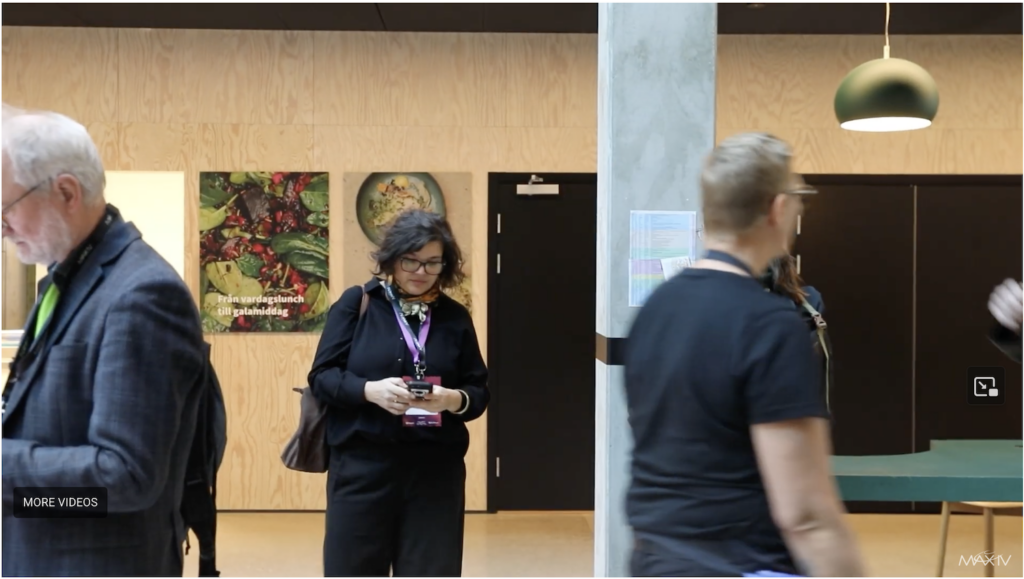
Choose your own inspiration
High-level topics at the parallel sessions ranged widely from advanced materials, low density matter, environment & Earth sciences, and supporting infrastructures, to catalysis, batteries, quantum materials, machine learning and health.
As a reflection of the AI buzz currently encompassing industries and work places worldwide, meeting speakers held machine learning presentations in rooms at full capacity. Andy Anker from the Technical University of Denmark (DTU) explained that ‘the future is self-driving’. To synthesize a material today takes 6 months conventionally, but machine learning will make it possible in 6 hours.
In the quantum materials session, Bastian Phau from the Max Born Institute and Jesper Wallentin from Lund University discussed imaging ferroic materials, particularly domain structures and their behaviour within devices.
In the health session, a focus area was on faster, more precise diagnosis using synchrotrons. Tobias Todsen from the University of Copenhagen spoke about phase-contrast imaging of cancer specimens, and Hanna Isaksson discussed arthritis diagnosis before the pain and before it’s too late to prevent.
Nazanin Emami from Luleå University of Technology explained for listeners the work designing polymers through the science of tribology and biotribology during the advanced materials session.
The poster session in the atrium displayed a notable 130 posters, with 80 of those from student submissions. Lund University postdoc Florian Schott received the poster prize for his topic, FoamQuant 4D quantification toolbox. The User Meeting PhD prize was awarded to researcher Alfred Larsson for his work, The Formation and Breakdown of Passive Films on Ni Alloys: in situ synchrotron-based studies.
MAX IV would like to thank all meeting speakers and participants for their engagement and enlightening discussions. The organisation also warmly acknowledges the record number of sponsors, especially gold sponsors AlfaLaval, PicoPascal and SmarAct, that made possible lower participant fees and higher attendance.